
Picture two ways to guard a vault full of money. In the first, thousands of people race to solve a hard puzzle, and whoever cracks it first gets to add the next page to the ledger and pocket a reward. In the second, people lock up their own cash as a deposit, take turns adding pages, and lose part of that deposit if they cheat. Both approaches keep the vault honest without a bank in charge. That, in a nutshell, is the difference between the two systems that run most of crypto.
When you compare proof of work vs proof of stake, you’re really asking one question: how does a network with no boss agree on what’s true? Bitcoin answers it one way. Ethereum answers it another. Understanding both makes a lot of crypto suddenly click, from why Bitcoin uses so much electricity to why “staking” is everywhere now.
Here’s how each one works, where they differ, and what any of it means if you’re just holding a bit of crypto and trying to follow along.
What a consensus mechanism actually does
A blockchain is just a shared record of who owns what. The tricky part is that no single company controls it. Thousands of computers around the world each keep a copy, so they all need a way to agree on the same version of history. Otherwise someone could spend the same coin twice.
The rule that gets everyone to agree is called a consensus mechanism. It decides who gets to add the next block of transactions and how everyone else confirms that block is legit. Proof of work and proof of stake are the two most common ways to do this. They aim for the same result, a trustworthy shared ledger, but they get there through very different incentives.

How proof of work works
Proof of work is the original. It’s what Bitcoin has used since day one, and it’s still going strong.
Here’s the idea. Computers called miners compete to solve a hard math puzzle. There’s no clever shortcut, so the only way to solve it is to guess, fast, billions of times per second. The first miner to land on the answer gets to add the next block and earns newly created coins plus transaction fees. Then the race starts again for the next block.
That puzzle solving burns real electricity, and that’s the whole point. To cheat the network, an attacker would need to redo all that work faster than everyone else combined. The security comes from the sheer cost of the computing power. Everyone agrees the valid chain is the one with the most work piled behind it, so honest miners naturally build on the longest, most expensive chain.
The upside is a track record. Bitcoin has run this way for over 15 years without its ledger being broken. The tradeoff is energy. All those machines guessing around the clock use a lot of power, which is the most common criticism of proof of work.

How proof of stake works
Proof of stake swaps raw computing power for skin in the game. Instead of miners burning electricity, you have validators who put up their own crypto as a deposit.
On Ethereum, running your own validator means locking up 32 ETH. The network then picks validators to propose and check new blocks, partly at random and weighted by how much they’ve staked. Do the job honestly and you earn rewards. That’s the carrot.
The stick is called slashing. If a validator tries to cheat, by signing conflicting blocks or otherwise breaking the rules, the network destroys part of their staked crypto and can kick them out. So attacking the system means putting your own money on the line and watching it get burned if you’re caught. You don’t need to out compute the network. You’d need to own a huge share of everything staked, and you’d lose it in the act.
Because there’s no puzzle to grind on, proof of stake uses a tiny fraction of the energy. The hardware is closer to a normal computer than a warehouse of specialized machines.
One note on the 32 ETH figure. That’s the amount to run a validator solo. Most people who stake don’t run their own, they use an exchange or a staking service that pools smaller amounts together, so you can stake far less than 32 ETH in practice. A 2025 network upgrade also gave large operators more flexibility in how much they stake per validator.
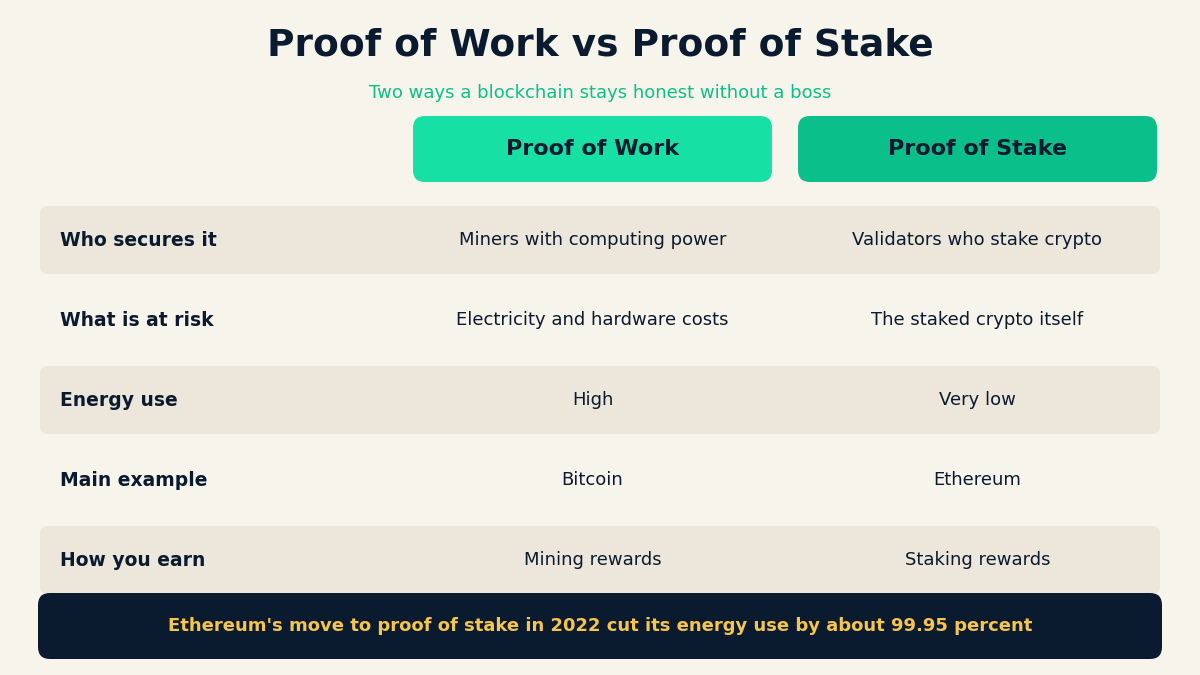
Proof of work vs proof of stake: the key differences
When you line up proof of work vs proof of stake side by side, a few differences stand out. Here’s the plain version.
| Factor | Proof of work | Proof of stake |
|---|---|---|
| Who secures it | Miners with computing power | Validators who stake crypto |
| What’s at risk | Electricity and hardware costs | The staked crypto itself |
| Energy use | High | Very low |
| Main example | Bitcoin | Ethereum |
| How you earn | Mining rewards | Staking rewards |
| Entry cost | Specialized mining rigs | Crypto to stake |
The energy gap is the headline. When Ethereum switched from proof of work to proof of stake in September 2022, an event known as the Merge, its energy use dropped by roughly 99.95%. That’s not a typo. The network went from consuming power like a small country to using a rounding error by comparison. Bitcoin, meanwhile, stayed on proof of work and still uses a large amount of electricity by design. If you want a closer look at these two coins themselves, our Bitcoin vs Ethereum guide breaks down how they differ.
Which one is more secure?
This is where people love to argue, and there’s no tidy winner. Both models are secure in different ways, and both have held up under real money and real pressure.
Proof of work’s strength is its long, boring track record and the physical cost of attacking it. To take over Bitcoin, someone would need to control more than half the world’s mining power. The equipment and electricity to pull that off would run into the billions, and even then the attack would likely tank the price of the coins they were trying to steal. The economics just don’t work.
Proof of stake leans on a different deterrent. To attack Ethereum, you’d need to control a massive slice of all the ETH staked on the network, and the moment you misbehaved, the protocol would start destroying it. You’d be lighting your own money on fire. It’s newer than proof of work, so it has fewer years on the clock, but the design makes cheating expensive in its own way.
So the honest answer is that neither is clearly “safer.” They’re two different bets on how to make dishonesty cost more than it’s worth.
What this means for you as a regular holder
You don’t need to run a miner or a validator to benefit from knowing this. But it does shape a few real world things.
If you hold coins on a proof of stake network like Ethereum, you may have the option to stake them and earn rewards, either yourself or through a beginner friendly app or exchange. That can be appealing, but it isn’t free money. Your crypto is usually locked up for a period, the reward rate changes, and if you stake through a service, you’re trusting that service to handle it well. Rewards also don’t cancel out price swings. The coin can still fall in value while you’re earning.
If you hold a proof of work coin like Bitcoin, staking generally isn’t a thing. Any product promising “Bitcoin staking rewards” deserves a hard look, because it usually means lending your coins to someone, which carries its own risks.
The bigger takeaway is simpler. Knowing how a coin secures itself helps you judge the project behind it and spot nonsense claims faster. That alone is worth the ten minutes.
A quick real world example
Say two friends each put $500 into crypto. One buys Bitcoin, one buys Ethereum. Behind the scenes, their money is protected by completely different machinery.
The first friend’s Bitcoin is kept honest by miners worldwide burning electricity to win the next block. The second friend’s Ethereum is kept honest by validators who’ve staked their own ETH and would lose it if they cheated. Neither friend has to do anything for this to work. But if the second friend wanted, they could stake their ETH and earn a little on top, while the first friend can’t stake Bitcoin the same way. Same starting amount, two different systems humming underneath.
Key takeaways
- Proof of work secures a network with computing power and electricity. Bitcoin uses it, and its security comes from the huge cost of attacking it.
- Proof of stake secures a network with staked crypto. Ethereum uses it, and cheaters lose their deposit through slashing.
- The energy difference is enormous. Ethereum’s move to proof of stake in 2022 cut its energy use by about 99.95%.
- Neither is clearly more secure. They’re two different ways to make dishonesty too expensive to bother with.
- For everyday holders, the main practical effect is that proof of stake coins can often be staked for rewards, with real tradeoffs, while proof of work coins usually can’t.
Frequently asked questions
Is proof of stake better than proof of work?
It depends what you value. Proof of stake uses far less energy and lets holders earn staking rewards. Proof of work has a longer track record and a security model based on real physical cost. Each has clear tradeoffs, so “better” really depends on your priorities.
Why does Bitcoin still use proof of work?
Bitcoin’s community values its simplicity and its long, proven history. Changing the core rules of Bitcoin is intentionally very hard, and many holders see proof of work as part of what makes it trustworthy. So it has stayed on proof of work while Ethereum moved on.
Does proof of stake mean I can earn money?
Staking can earn rewards on some networks, but it isn’t guaranteed income. Your crypto is usually locked for a time, reward rates shift, and the coin’s price can still drop. If you stake through a platform, you’re also trusting that platform. Treat it as a feature with risks, not a sure thing.
Which cryptocurrencies use proof of stake?
Ethereum is the biggest. Many others use proof of stake or a variation of it, including Cardano, Solana, and Polkadot. Bitcoin and a handful of others remain on proof of work. If you’re curious about a specific coin, its official site usually states which model it uses.
What is slashing in proof of stake?
Slashing is the penalty for validators who break the rules, like signing conflicting blocks. The network destroys part of their staked crypto and can remove them. It’s the mechanism that makes cheating expensive, and it’s very hard to trigger by accident if you’re playing fair.
The bottom line
Proof of work and proof of stake are just two answers to the same question: how do you keep a shared ledger honest without a middleman? One spends electricity to make cheating costly. The other puts real money at stake and burns it if you cheat. Bitcoin rides on the first, Ethereum on the second, and now you can tell them apart and understand why the energy debate exists at all. For more plain English breakdowns like this one, browse our Learn section.
This article is general information, not financial, investment, or tax advice. Crypto is volatile and staking carries its own risks, including lock up periods and platform risk. Only put in what you can afford to lose, and do your own research before making any decision. Facts were verified on the publish date.