Ask three crypto holders where they buy and you’ll get three answers, each delivered with total confidence. One swears by the app that made signing up painless. One moved everything to whichever platform had the lowest fees that month. One is still on the account they opened in 2021 and has never checked what it costs them.
All three can be right, because exchanges aren’t really competing on the same thing. Some sell convenience. Some sell price. A few sell caution, which is a much harder product to market.
What almost nobody does is look at the handful of things that actually separate one platform from another: what you pay, how your coins are held, what you can do there, and what you’re left holding if the company goes sideways. A useful crypto exchange comparison covers all four. That’s what the rest of this guide does.
What actually differs between exchanges
Strip out the marketing and there are four real variables.
Cost. Not the headline fee, but the trading fee plus the spread baked into the price you’re quoted plus whatever it takes to move money in and out.
Custody. Who holds the coins, where they sit, and what evidence exists that they’re actually there.
Coverage. Which assets you can buy, whether staking is offered, and how the rules change depending on where you live.
Recourse. What protection you have when something breaks. In crypto that’s usually less than people assume.
Almost everything else is interface design.
The crypto exchange comparison at a glance
Here’s how five platforms US buyers run into most often stack up. These are starting tier rates on each platform’s advanced or pro interface, which is where the cheaper pricing lives. Fee schedules change, sometimes with only a few days of notice, so treat this as orientation and check the current fee page before you trade.
| Platform | Starting fee (pro interface) | Known for | Worth knowing |
|---|---|---|---|
| Kraken Pro | About 0.25% maker, 0.40% taker | Low starting fees, wide staking menu | In July 2026 it moved to tiers set by 30 day volume or assets held, whichever helps you more |
| Coinbase Advanced | About 0.40% maker, 0.60% taker | Largest US listed name, roughly 260 assets | The simple buy screen costs noticeably more than Advanced |
| Crypto.com Exchange | Around 0.25% maker, 0.50% taker | Card and app ecosystem, VIP tiers | Buying inside the app pays a spread instead of a listed fee |
| Gemini ActiveTrader | 0.60% maker, 1.20% taker at the base tier | New York trust charter, conservative listings | The priciest starting tier here by a wide margin |
| Robinhood Crypto | No separate commission | Simplest onboarding for stock investors | Cost sits inside the spread, so it’s the hardest to measure |
Every crypto exchange comparison table has the same weakness. It shows the number the platform publishes, not the number you end up paying. That gap is where the next section lives.

Fees: where the money quietly leaks out
Most people check the trading fee, see a number under one percent, and stop looking. Three separate costs are stacked on top of each other, and only one of them is advertised.
Maker and taker fees, in plain English
A maker order sits on the order book and waits. A taker order matches something already there and fills right now. Exchanges charge takers more because makers are doing them a favor by providing liquidity.
If you buy at the market price, you’re a taker. Nearly every beginner is a taker every single time, which means the taker column is the one that matters to you. On Kraken Pro that’s about 0.40% at the starting tier. On Coinbase Advanced it’s about 0.60%. On Gemini’s ActiveTrader the base tier is 1.20%, which is three times the Kraken number for the same trade.
The simple screen versus the pro screen
This is the single most expensive habit in retail crypto. Most exchanges run two interfaces: a friendly one with a big buy button, and a busier one with an order book. The friendly one usually costs more.
Coinbase’s simple buy flow adds a spread of roughly half a percent on top of its transaction fee, and that spread can widen when markets get choppy. Same company, same coin, same second in time. Different price. The simple buy screen is where most beginners overpay, and switching to the advanced view takes about thirty seconds.
The costs nobody puts on the pricing page
Card purchases carry the worst rates almost everywhere. Bank transfers are usually free or close to it, but take days. Withdrawing to your own wallet costs a network fee that some platforms mark up on top.
Then there’s the spread, the difference between what the platform will buy from you at and sell to you at. On commission free apps that spread is the whole business model. It never shows up on a receipt, so the price you’re quoted is not the price you’d get selling back a second later.

Safety: what a safe exchange actually means
Ask an exchange if it’s safe and it’ll point at cold storage, audits, and a big insurance number. Those things are real, but they don’t mean what most readers assume. This is the part a crypto exchange comparison built purely on fees will skip, and it’s the part that decides whether a bad year costs you a few dollars or everything.
Cold storage and proof of reserves
Cold storage means most customer coins sit on hardware that isn’t connected to the internet. Coinbase reports keeping roughly 98% of assets offline, and a cold storage ratio above 95% is the rough industry bar for a serious platform.
Proof of reserves is the other transparency signal. An exchange publishes a snapshot showing it holds the assets customers are owed. Useful, but incomplete: a reserves snapshot shows what a company has, not what it owes elsewhere. A platform can pass a reserves check and still be quietly insolvent because of debts that never appear in the report.
What insurance does and doesn’t cover
Here’s the line that trips up almost everyone. Crypto held on an exchange has never been FDIC insured, and it isn’t SIPC protected either. If you keep US dollars on a platform and those dollars sit at a partner bank, the cash portion may be covered at that bank. The coins never are.
US regulators tightened the labeling on this in January 2026, requiring platforms to mark crypto balances clearly as non deposit products. Private policies exist and vary: Gemini reported carrying $125 million in digital asset coverage as of March 2024, split between hot wallet crime coverage and cold storage. That protects against specific failures at the custodian. It is not a guarantee on your balance.
Regulation is a signal, not a shield
Gemini has operated under a New York limited purpose trust charter since 2015, bringing NYDFS oversight on capital, anti money laundering controls, and cybersecurity. Coinbase is a publicly listed US company with audited financials. Both facts are meaningful, and neither prevents a hack or a bankruptcy. The Bybit breach in February 2025 took roughly $1.5 billion from a large, established platform.
The practical takeaway is old and boring and still correct. An exchange is a place to trade, not a place to store. Whatever you aren’t actively using should move to a wallet whose keys you control, which our guide on how to store crypto safely walks through.
Features: what you’ll actually use
Feature lists run long and most of it is noise. Four things tend to matter.
Asset selection. Coinbase supports roughly 260 assets. Gemini deliberately lists far fewer, in the range of 70 to 80, because its listing process is more conservative. If you only want bitcoin and ethereum, this difference is irrelevant. If you want something obscure, it decides everything.
Staking. Coinbase, Kraken, Gemini, and Crypto.com all offer it, with published rates. Kraken tends to support more assets and offers both locked and flexible options. Availability still varies by state, so check before you assume.
Tax reporting. Some platforms hand you clean exports, some hand you a mess. If you trade more than a few times a year this quietly becomes the feature you care about most, and the tax software roundups in our Guides section cover the tools that clean it up.
Getting money out. Test a small withdrawal early, while the amount is small enough not to matter. Learning that a platform’s withdrawal process is slow or awkward is much cheaper as a $20 experiment than as a $5,000 emergency.
The same $1,000 buy, three different ways
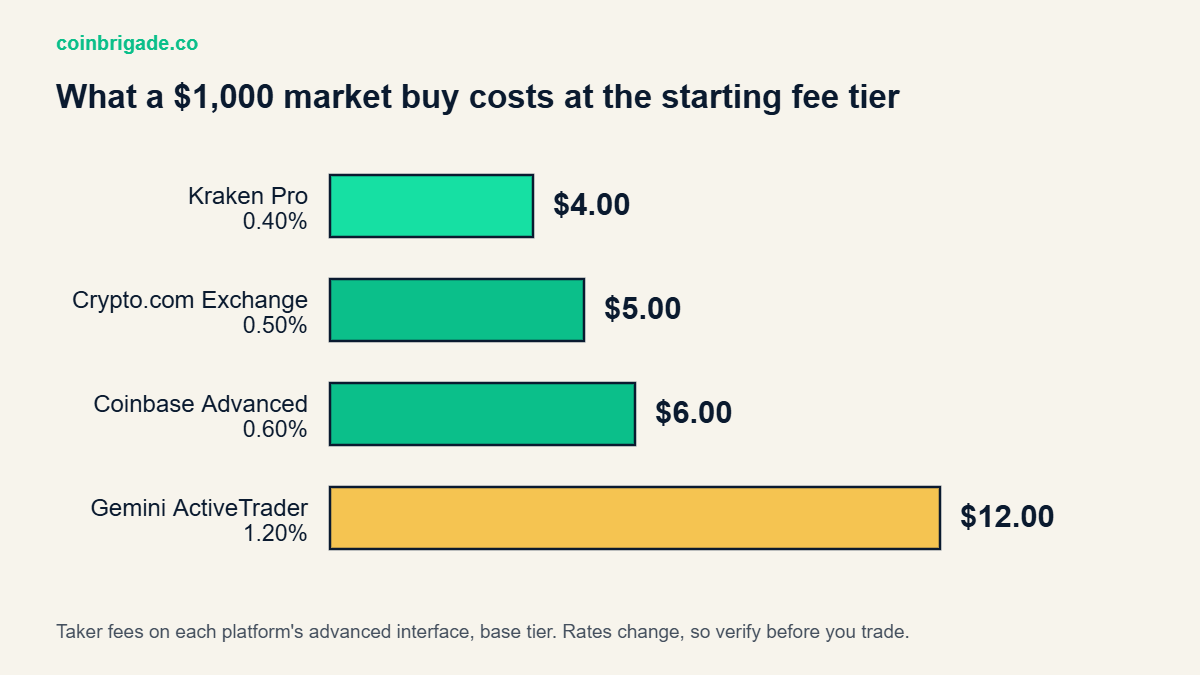
Numbers make this concrete. Say you’re buying $1,000 of bitcoin as a market order at each platform’s starting tier.
On Kraken Pro at 0.40% you pay $4. On Coinbase Advanced at 0.60% you pay $6. On Gemini’s ActiveTrader base tier at 1.20% you pay $12. Now use Coinbase’s simple buy button instead of Advanced and you’re also absorbing a spread of around half a percent, roughly another $5, on a trade where the advanced screen would have charged you $6.
On one buy, the gap between cheapest and priciest is a few dollars. Nobody switches platforms over that. But run a $500 buy twice a month for two years and you’ve made 48 trades, and the difference between 0.40% and 1.20% is real money that bought you nothing.
The flip side is worth saying too. If a pricier platform is the one whose security you trust and whose interface you won’t fumble, paying a few extra dollars a trade is rational. Fees are one input, not the answer.

How to choose the one that fits you
Work through these in order.
- Confirm the platform operates legally where you live and supports the assets you want. This eliminates options fast.
- Look up the taker fee on the advanced interface, not the headline rate on the marketing page.
- Check deposit and withdrawal costs for the funding method you’ll actually use.
- Read what the platform publishes about custody and reserves. If you can’t find it easily, that’s information.
- Turn on two factor authentication with an app rather than text messages, before you deposit anything.
- Make a small test buy and a small test withdrawal to a wallet you control.
Step six is the one people skip, and it’s the one that teaches you the most. If you’re picking your first platform, our roundup of the best crypto apps for beginners covers the onboarding side in more detail. And if you’d rather hold exposure without holding coins at all, bitcoin ETFs are a different route with its own set of trade offs.
There’s one question no crypto exchange comparison can answer for you: how much are you willing to pay for an interface you find calm? For some people that number is zero. For others it’s worth a few dollars a trade. Both answers are defensible.
Key takeaways
- Cost is three things stacked: the trading fee, the spread, and the money movement fees. Only the first is advertised clearly.
- The advanced interface is cheaper than the simple buy screen on the same platform, often by a lot.
- Starting taker rates run from about 0.40% on Kraken Pro to 1.20% on Gemini’s base tier. Over dozens of trades that gap compounds.
- Crypto on an exchange isn’t FDIC or SIPC insured. Cold storage and proof of reserves are real signals, not guarantees.
- Regulation and public listings reduce risk without removing it. Bybit lost roughly $1.5 billion in February 2025.
- Trade on the exchange, store off it. Move anything you aren’t actively using to a wallet you control.
Frequently asked questions
Which crypto exchange has the lowest fees?
Among the major US platforms, Kraken Pro tends to start lowest at roughly 0.40% taker, with Coinbase Advanced near 0.60% and Gemini’s base tier at 1.20%. Commission free apps look cheapest and often aren’t, because the cost hides in the spread. Rates change, so verify on the platform’s own fee page.
Is it safe to keep crypto on an exchange?
It carries risk that a personal wallet doesn’t. You’re trusting the company to stay solvent, stay unhacked, and let you withdraw. Exchanges are reasonable for actively traded amounts and poor for long term storage. Anything you plan to hold for years belongs in a wallet you control.
Do I need more than one exchange account?
Plenty of people run two: one cheap platform for buying, one that lists an asset the first doesn’t carry. A single account freeze then doesn’t lock you out entirely. The cost is more accounts to secure and more records at tax time.
Why is the price different on two exchanges at the same moment?
Each platform runs its own order book, so prices drift apart based on local supply and demand. Gaps are small on major coins and wider on thin ones. Compare the price you’re actually quoted, not the headline market price.
What’s a maker fee versus a taker fee?
A maker order rests on the order book and waits for someone to fill it. A taker order fills immediately against an existing order. Takers pay more. If you use the market buy button, you’re a taker.
Does the exchange I choose affect my taxes?
Not what you owe, but very much how painful it is to work out. Platforms differ a lot in the quality of their transaction exports, and messy records are the main reason crypto taxes turn into a weekend project.
What should I check before depositing money?
That the platform serves your state, that two factor authentication is on and using an app rather than text messages, that you know the taker fee on the advanced interface, and that you’ve tested a small withdrawal.
A note on this article
This is general information, not financial, investment, or tax advice. Fees, features, and availability were verified against each platform’s published materials on the date this was written and change often, including Gemini’s fee schedule dated July 9, 2026 and Kraken’s tier restructure the same month. Confirm current terms on the platform’s own fee schedule before you trade. Crypto is volatile and largely uninsured. Only risk what you can afford to lose, and remember that self custody puts the responsibility for your keys entirely on you.
More context and market explainers live in our Markets section.