
A friend of mine wanted to own some bitcoin last year, but she kept stalling. She wasn’t worried about the price. She was worried about losing it. The stories about people locking themselves out of their own wallets, or writing a recovery phrase on a sticky note and watching it vanish, spooked her enough that she never pressed buy. Then her brother mentioned he’d bought bitcoin inside his regular brokerage account, the same place he holds his index funds, with no wallet and no seed phrase to guard. That’s a bitcoin ETF, and it’s the reason a lot of cautious people finally got off the sidelines.
So let’s get bitcoin ETFs explained in plain terms, because the idea is simpler than it sounds. A bitcoin ETF is a fund that trades on a normal stock exchange and tracks the price of bitcoin. You buy shares of it through a brokerage the same way you’d buy shares of any stock or fund. When bitcoin’s price moves, the value of your shares moves with it. You get the price exposure without ever touching a crypto exchange, a wallet, or a recovery phrase.
That convenience is the whole appeal, and it comes with real tradeoffs. Here’s how these funds actually work, what they cost, and where they help or hurt.
Bitcoin ETF explained: what it actually is
ETF stands for exchange traded fund. It’s a basket that holds something and issues shares you can trade during market hours. A gold ETF holds gold. An S&P 500 ETF holds the 500 companies in that index. A bitcoin ETF holds bitcoin, or contracts tied to bitcoin, and its share price is meant to shadow the coin.
The key thing to understand is that you don’t own the underlying bitcoin directly. You own shares in a fund that owns the bitcoin. The fund and its custodian handle storage, security, and the private keys. You just hold shares in your brokerage account, and you can sell them the same way you bought them.
This is a big deal for people who want the exposure but not the responsibility. There’s no seed phrase to lose, no wallet software to set up, no worry about sending coins to the wrong address. If you’re still deciding whether that responsibility is for you, our guide on what a seed phrase is walks through what self custody really involves. For that reason a lot of first time buyers, and plenty of retirement accounts, have used ETFs as their front door to bitcoin.

Spot vs futures: the difference that matters most
Not all bitcoin ETFs hold bitcoin. This trips people up, so it’s worth slowing down here. There are two main types, and they behave differently.
A spot bitcoin ETF holds actual bitcoin. When money comes into the fund, it buys real coins and stores them with a custodian. The share price tracks the current, or spot, price of bitcoin fairly closely. This is the type most people mean today when they talk about a bitcoin ETF.
A futures bitcoin ETF holds bitcoin futures contracts instead of the coin. Futures are agreements to buy or sell bitcoin at a set price on a future date, traded on the Chicago Mercantile Exchange. These contracts expire, so the fund has to keep rolling into new ones. That rolling can create a small drag on returns over time, which is why a futures ETF may not track bitcoin’s price as cleanly as a spot fund.
Futures ETFs came first in the United States, back in 2021, because regulators were more comfortable with them. Spot funds took years longer. For most everyday buyers wanting to mirror bitcoin’s price, a spot fund is the more direct tool. Always check which type a fund is before you buy, because the label can look almost identical from the outside.

How the spot ETF era started
Spot bitcoin ETFs are newer than people assume. On January 10, 2024, the SEC approved eleven spot bitcoin ETFs at once, and they began trading the next day. That was the moment the whole category opened up in the United States, after more than a decade of rejected applications.
The launch pulled in serious money. Big names like BlackRock, Fidelity, and Grayscale ran the largest funds, and demand climbed quickly as brokerages and financial advisors could finally offer bitcoin exposure through a familiar wrapper. By April 2026, total assets across all the spot bitcoin ETFs crossed 100 billion dollars for the first time, with roughly 1.3 million coins held across the products.
Those numbers move with bitcoin’s price, so any single figure is a snapshot rather than a fixed truth. A swing in the coin can shift the total by billions in a day. The point isn’t the exact dollar amount. It’s that these funds went from brand new to a meaningful slice of the market in about two years.
What bitcoin ETFs cost
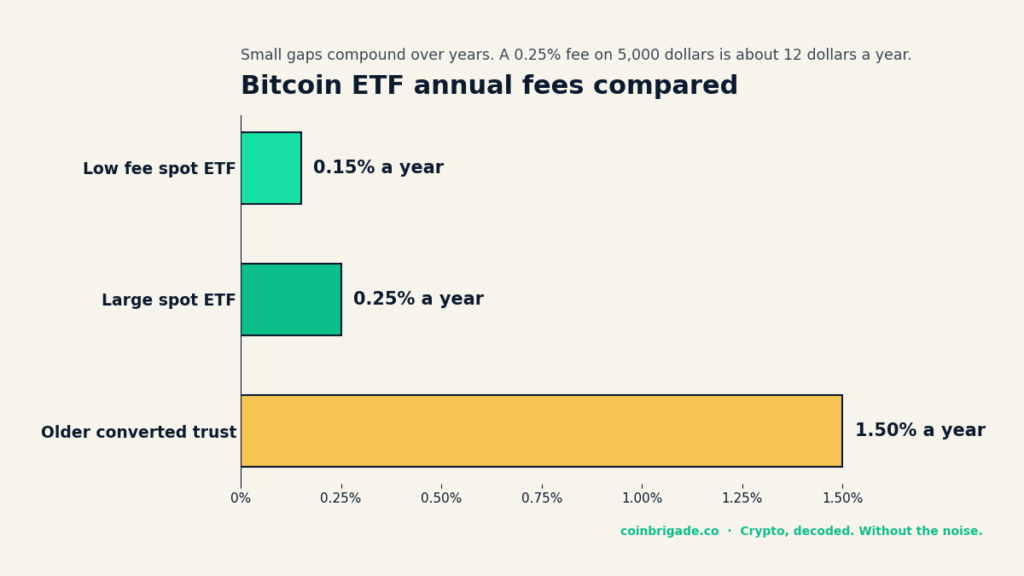
ETFs charge an annual fee called an expense ratio. It’s taken out of the fund gradually, so you won’t see a separate bill, but it quietly reduces your return every year. On a bitcoin ETF, fees have landed in a fairly tight band, and small differences add up over the long haul.
Here’s a rough comparison of where the major spot funds sit. Verify the current numbers before you buy, because funds adjust fees and run promotions.
| Fund type | What it holds | Typical annual fee | Best for |
|---|---|---|---|
| Large spot ETF (for example IBIT, FBTC) | Actual bitcoin | Around 0.25% | Most buyers wanting simple, direct exposure |
| Low fee spot ETF (for example a mini trust) | Actual bitcoin | Around 0.15% | Cost focused long term holders |
| Older converted trust (GBTC) | Actual bitcoin | Around 1.50% | Rarely the cheapest choice today |
| Futures ETF | Futures contracts | Varies, plus roll costs | Traders, not usually long term holders |
To put that in real money, a 0.25% fee on a 5,000 dollar position is about 12 dollars a year. The gap between a 0.15% fund and a 1.50% fund is far larger, and it compounds. When Grayscale converted its older trust into an ETF in 2024, it kept a 1.50% fee while newcomers charged a fraction of that. Billions of dollars flowed out of the expensive fund and into cheaper ones. Fees matter, and investors voted with their money.

The tradeoffs: convenience vs control
An ETF solves the storage problem, but it hands you a different set of limits. It helps to see both sides plainly before you decide.
What you gain
You skip self custody entirely. No wallet, no keys, no phrase to protect. You buy and sell inside an account you already understand, and you can often hold a bitcoin ETF in a tax advantaged account like an IRA, which is hard to do with coins on a crypto exchange. Your shares also come with the reporting and structure of a regulated fund, which many people find reassuring.
What you give up
You never actually hold the bitcoin, so you can’t move it, spend it, send it to someone, or use it in the wider crypto world. You can’t withdraw the coin to your own wallet. There’s the old saying in crypto, “not your keys, not your coins,” and with an ETF the keys belong to the fund, not to you.
You’re also on the stock market’s clock. Crypto exchanges trade 24/7, but a bitcoin ETF only trades during regular market hours, roughly 9:30 in the morning to 4:00 in the afternoon Eastern time, on business days. If bitcoin lurches over a weekend, you can’t trade your ETF shares until the market reopens. And you still pay that annual fee, which owning the coin outright doesn’t charge you.
Is a bitcoin ETF right for you?
That’s a personal call, and it depends on what you want out of owning bitcoin. If your goal is simple price exposure inside a normal investment account, and the idea of guarding a recovery phrase keeps you up at night, an ETF removes that worry. If you want to actually use bitcoin, hold your own keys, or move money outside market hours, buying the coin through an exchange and holding it in your own wallet fits better. It also helps to understand the asset itself first, like the difference between bitcoin and ethereum, before you pick how to own it. For more market explainers, browse our Markets section.
Plenty of people use both. They keep a core position in an ETF for the retirement account and hold a smaller amount of real coins to learn self custody. There’s no single right answer, only the one that matches how hands on you want to be.
Whatever you choose, remember that a bitcoin ETF gives you all of bitcoin’s price swings. It doesn’t smooth them out or protect you from a drop. The coin has lost more than half its value more than once, and an ETF falls right along with it. Only put in what you can afford to lose, and give yourself time to understand the asset before committing much.
Key takeaways
- A bitcoin ETF is a fund that trades on a stock exchange and tracks bitcoin’s price, so you get exposure through a normal brokerage with no wallet or seed phrase.
- Spot ETFs hold real bitcoin and track the price closely. Futures ETFs hold contracts and can drift over time. Check which type you’re buying.
- The SEC approved the first spot bitcoin ETFs on January 10, 2024, and the category grew past 100 billion dollars in assets by April 2026.
- Fees usually run around 0.15% to 0.25% on the big spot funds, with one older trust much higher. Small fee gaps compound, so compare before buying.
- You gain convenience and IRA access, but you give up direct ownership, the ability to move your coins, and around the clock trading.
Frequently asked questions
Do I actually own bitcoin if I buy a bitcoin ETF?
Not directly. You own shares in a fund that owns the bitcoin. The fund holds the coins and the keys, and you can’t withdraw the coin to your own wallet. You get the price exposure, not the coin itself.
What’s the difference between a spot and a futures bitcoin ETF?
A spot ETF holds actual bitcoin, so its price tracks the coin closely. A futures ETF holds contracts that bet on bitcoin’s future price and must be rolled over as they expire, which can cause its return to drift from the coin over time.
Are bitcoin ETFs safe?
The ETF structure removes the risk of losing your own keys, and the funds are regulated. But the price risk is exactly the same as owning bitcoin. If the coin drops sharply, your shares drop with it. “Safe” here means safer storage, not a safer price.
Can I hold a bitcoin ETF in my retirement account?
Often yes. Because a bitcoin ETF trades like a normal fund, many brokerages let you hold one in a tax advantaged account such as an IRA. That’s one of the main reasons people choose an ETF over holding coins on a crypto exchange. Check with your brokerage first.
Which bitcoin ETF is the cheapest?
Fees shift, but the big spot funds have clustered around 0.15% to 0.25% a year, while one older converted trust has stayed near 1.50%. The lowest fee isn’t the only thing that matters, but on a long term hold it’s worth comparing. Verify the current expense ratio on the fund’s own page.
Can I trade a bitcoin ETF on weekends?
No. A bitcoin ETF only trades during regular stock market hours on business days, roughly 9:30 a.m. to 4:00 p.m. Eastern. Bitcoin itself trades 24/7, so the coin can move while the market is closed and you won’t be able to trade your shares until it reopens.
This article is general information, not financial, investment, or tax advice. Crypto is volatile and you could lose money. Figures were verified on the publish date and change with the market. Do your own research and speak with a licensed professional about your situation.